Sunday, 29 June 2014

First Month Down...

So I finished my first month working at Ubisoft and living in France. It has been good, I think acclimatising to the heat will be slow and difficult, the language has also been a tough thing to sort out.

Art-wise I've been working on marketing art for Valiant Hearts whether that be gifs for journalists to use or perfecting screenshots. I'm nots sure what I'll be working on from now on but the launch party was last week and although I only worked on it for a month I went along and met some new people in the company. As Valiant Hearts is all painted and drawn by one artist its been difficult to meet other artists so far. Also Valiant Hearts has an awesome story and I really recommend it, if you haven't seen the trailer prepare yourself.


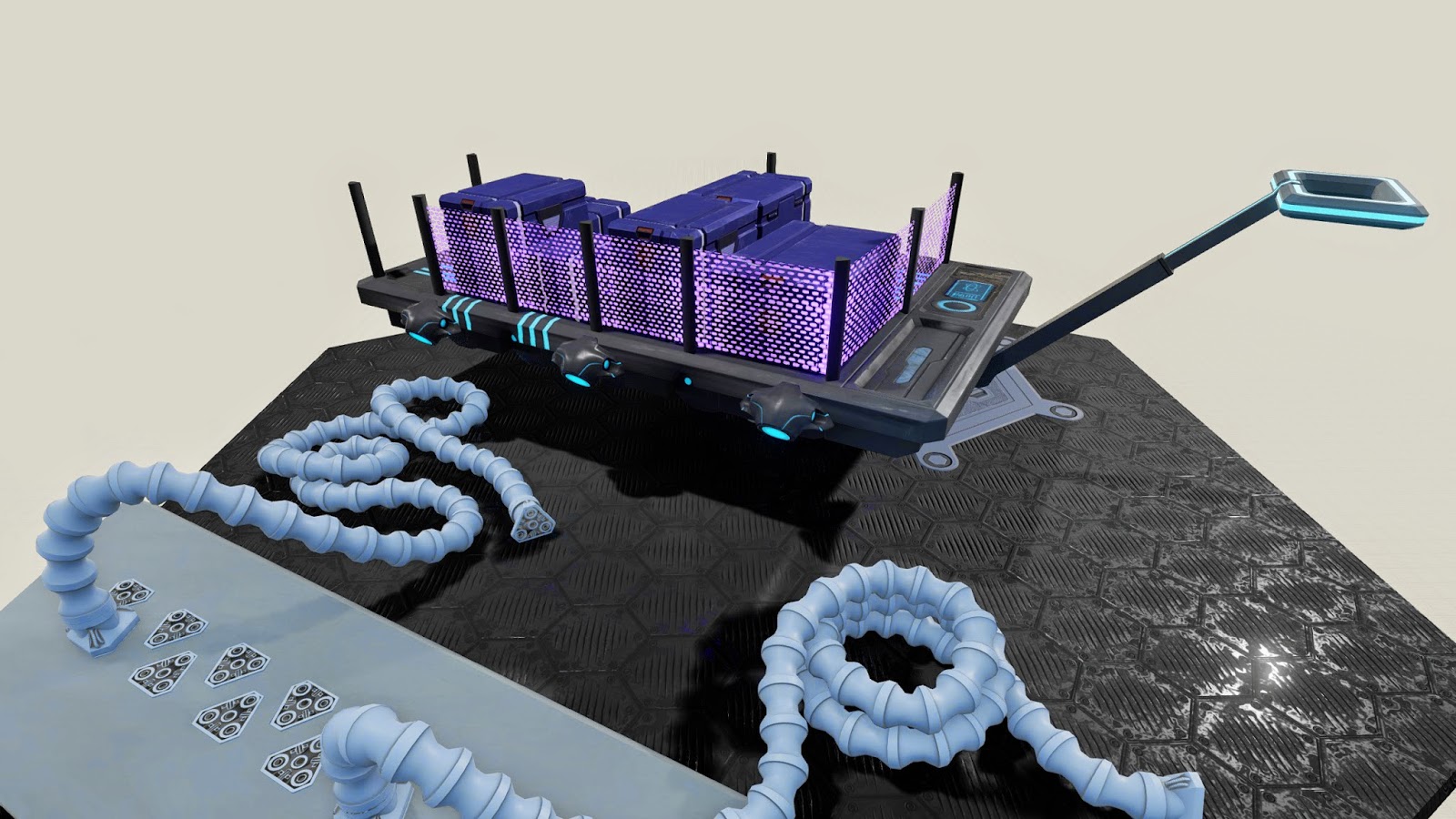
Aside from that I've been trying to finish off the Cart project but unfortunately I really don't like where it has gone, it simply looks poor and messy, so I think I'm going to go more towards a small turntable idea with a hatch on the floor and some wires and cables dragging around the floor but the cart will be central and focused. Making these changes will allow me to learn more and spend my time better, I'm going to rig and animate the cart, make particle effects for the thrusters, work on materials especially the forcefield and I'm going to try and use matinee to record it a turntable. Below are some images of how its looking at the moment and as you can see its not really working even though its early days, so I think I'm going to try and make more of a turntable for it.


Alongside this I am also working on some of the planning stages for my summer project, I chose the title Ruins to work on and have decided to create an environment based off Turner's "Caligula's Palace and Bridge" painting. The idea is to create the environment so that the spawn position is framing the environment in the same way as Turner's painting. The reason for this is so that I can use this project as a test for an idea I have for my Final Major Project that I'm not sure about. I want to create a gallery space where you can enter into famous/master's paintings. With Turner and constable style paintings I feel that the visual style shouldn't be too far off realism however I am uncertain about certain things such as lighting and fog.

"Caligula's Palace and Bridge" by J M W Turner
An engraving based on Turner's painting by Edward Goodwill. Found here
As you can see Turner's painting is very foggy and interesting, this will be pretty tough to replicate and I will update soon as I have started to play about with this idea. Fortunately for me some other artists used Turner's paintings for some more refined pieces allowing me to use them as reference for the architecture.

Lastly, working hard is difficult here for some reason I don't know why but in Leicester I could work all day at uni and then carry on. Here I'm finding that mentality pretty difficult to find. Lets hope I can get it back because I NEED to get better and I NEED to improve my portfolio and I NEED to make the most of working for the likes of Ubisoft...

Monday, 26 May 2014

Montpellier and Day One at Ubisoft

So last Thursday I got on the plane and left my comfort zone behind, I said good bye to it hoping to meet it again sometime soon. Since then I've been living, exploring and taking photos in Montpellier. The south of France is nice but dusty. I flew not having anything more than a week of accommodation, I had a lead for a possible room and I knew that I needed to make a French bank account and get a French sim card but all of this had to be done with poor GCSE standard French and not much money. Below are a selection of photos from my first few days.


I'm happy to say so far things have gone more smoothly than I was expecting, I have accommodation for the first 3 months and maybe more, I have set up a French bank account, I have a French phone number and I have finished my first day as a Ubisoft employee! I saw some cool stuff, no more shall be said of it, but it was cool, however because it was my first day I didn't get much to done or much to do. I have been told that during the first period of my internship I am to show them what I am capable of so that I can assist with the correct area. I don't think I've ever felt so motivated to create awesome things and show what I am able to do. I will say if there's anything I was scared of, it was this. I was hoping to be the bottom of the ladder and being told what to do because well I suppose that's easier, how ever tough the work may be, you know what you're meant to do. However this has been handed to me so I have some ideas of what I can do to show. I just hope they're enough and they are as desired. Its on my back to do stuff! this means I might be quite busy for the next couple of weeks, here is where I got to with the cart project, I have changed a fair amount and I'm nearly done with the crates.


Friday, 16 May 2014

Review of Second Year

Its only just setting in that my penultimate year of education is pretty much over. It has been a weird but great year and I feel that I understand University education a great deal better now. During first year I sounded really keen and dedicated but I don't think I necessarily proved to be so. I wasn't doing extra work, I was barely teaching myself on the side, self-motivated learning wasn't particularly high up on my to do lists.

With more interesting projects came a desire to learn above and beyond what we were being taught. I feel working above and beyond what you are told to do is what university education is about. Also a job in the industry seemed a lot closer at hand and I knew that I would have to really work hard to secure one this year or next. This drove me to be continuously making extra things or learning about new techniques in my spare time. Most people go to university having experienced a fairly spoon-fed school system and expect that to continue especially with the amount we are in debt for the fees. I hear a lot of "this isn't worth £9,000 a year" and I used to be one of those people but from the start of this year I had realised that we truly have a brilliant course with a brilliant selection of tutors who put the hours in. If you see this and show that you are inquisitive and excited to learn you can easily get your money’s worth. Neil deGrasse Tyson is very good at explaining how I feel education works best. He talks about how you should let children break things, drop things and generally make mistakes. The idea is that experiential learning is essential and the idea that play and learning things aren’t different things. From a young age my brother attempted to make me teach myself pieces of software, hardware… well I guess he just wanted me to teach myself anything rather than being taught things by someone else. Obviously teachers still play a pivotal role in education and below is Neil deGrasse Tyson explaining the importance of teachers.
My university work itself has been alright although I don't feel I've seen the improvement within Visual Design that I would have liked and in Game Production the group project sapped away a great deal of time and I don't feel I have much to show for it. Critical Studies on the other hand yet again I started off well with posting quite regularly about what I was doing and new and interesting things alongside the required tasks but this tailed off around the time I got a job in a restaurant and doesn't seem to have picked up again. This again is where I want to improve and I'm trying to work out a way to do this and keep the productivity going.


That being said, the private company side of universities seems to actually let them down. Having seen the influx of first years and the effect on the course I became worried that the desire for money from the university ruined the idea of educating people. However the lecturers on the course seem particularly capable of not letting this happen, and no matter what, manage to provide some very in depth tuition.


My goals for the course are to learn as much as possible and to get into the industry and continue learning. I am lucky enough to have secured an internship at Ubisoft Montpellier in the south of France and feel that I am ready for this next step in my learning.

Sunday, 27 April 2014

Life Changing or Career Building?

With the games industry being what it is, a fringe of the creative industry it is very tricky to know how to educate people for the industry. There is a great deal of technical knowledge, understanding and thought process which you need to have to be successful within the industry. Much of this is also quite specific to this creative industry however this can definitely be taught and probably in less time than 3 years which leaves the possibility of a great artist or programmer being hired and taught the skills while working or while on an internship. While that may have been the technique used at the start of the industry its got to the point now where that isn't necessarily the most efficient way of hiring people.

Why would you hire someone who has less experience of the technology and techniques over someone who has spent 3 years learning how to do things and has been able to play with these techniques to find out new and interesting ways to do things or find out how definitely not to do things? Under the guise of needing people with a good liberal arts background? Well personally I feel that the views displayed in the brief are not as opposing as they seem.

"Some game companies want highly trained graduate artists and programmers. 
Some claim they really prefer creative individuals with a good Liberal Arts 
background. They can’t both be right can they? How can education meet these 
opposing views and yet provide a valid and fulfilling experience to students?"

Is a master painter not both a highly trained artist and a creative individual with a good liberal art background? I'm not saying that people on this course end as master painters but I'm meaning to question the idea that you can't be both highly trained and have a good liberal arts background. I feel having been on the course for 2 years now that we aren't being taught to focus on games and nothing else; if anything we're being persuaded to open out to more than games, and focus on art in general, focus on politics and life. We are learning the technical skills and being taught how to learn. The later being something that I wish I had had better earlier on in my life, the course goes a bit further than my brother telling me to play with software if I want to achieve a certain result, "the more you play around the more you'll learn" he said. Well that has been explained further while on this course 13 years later.

With the whole degree or no degree thing there has been an interesting article floating around recently which made me think about this a great deal more than I had previously. This article discusses what developers think of education, however this is more looking at game design instead of game art. I found it very interesting as I have never felt that University puts you above anyone or that having a degree in game art would make me a better hire than anyone else however I did think that I may be given 3 years to focus on becoming a better artist. That is the important thing, university/a degree is what you make it, it is 3 years to make mistakes to learn techniques to gain a better understanding of both the fundamentals of art and the technical aspects of game creation and pipelines.

Creativity, the Talent, Myth and Craft

"For talent without craft is like fuel without an engine. It burns wildly but accomplishes nothing"
Robert McKee

This quotation is the heading to this blog post's brief, it seemed quite apt at explaining the difference between creativity and talent when I first read it. After re-reading it and thinking about it I became quite confused. Lets play with the quotation and see what comes of it.

"For creativity without craft is like fuel without an engine. It burns wildly but accomplishes nothing"

Seems to make sense. Creativity means you come up with interesting and different approaches to things, but without craft you haven't produced anything just thought of different ways to approach them. To me here creativity as a word seems to mean a thought process.

"For creativity without talent is like fuel without an engine. It burns wildly but accomplishes nothing"

Seems to make sense. Creativity without the talent to produce the idea well leaves you with a really nice idea rendered poorly. Personally I feel like this is the first stage of being an artist and I have experienced this dilemma a great deal, when you live in the possibilities and in your head, you can easily "burn wildly" with possibility but accomplish little.

"For talent without creativity is like fuel without an engine. It burns wildly but accomplishes nothing"

Seems to make sense. Talent without creativity means that you can do something well but there is no interest to it, I personally find this with the photo-realistic paintings that have been presented in the BP Portrait award for the past few years. They are huge and impressive but seem to do little more than show how good the painter is, often they are fairly uninteresting and lack creativity.

Creativity is useful in both the idea and how to accomplish the idea, it is often thought of as the "artistic" and "softer" version of talent. Steven Spielberg showed great creativity and talent when he solved the problem of the fake shark not working until the end of the shoot of Jaws, many film director use creativity and understanding to problem solve. Creativity, innovation and problem solving to me are the same process but creativity seems like a new way of doing something, innovation seems like using what is there already to better it and problem solving is simply the process of fixing an issue.

As an artist creativity is gold dust and personally I find that it is really difficult to find, after having watched this I am slightly worried that I have been educated out of creativity.


This documentary also made me think about what creativity is and how to take advantage of it...


And finally here is the expected John Cleese speech about creativity which I think is brilliant, and the opening line is perfect.

"Telling people how to be creative is easy, its only being it that's difficult"


An Introduction to the Games Industry

The games industry has been growing up and in the recent decade has got to the stage that even indie development studios aren't necessarily "bedroom coders", some are but most aren't. The question often arises between specialist and generalist, not just on our course but in almost any area people think about pursuing. If we focus on game art for the moment; the decision to try and become a character artist is an incredibly though one as that is most certainly a field that requires either immense specialisation or years and years of experience.

Specialisation is something that people expect to have gone to far extremes and often people expect the AAA studios to be factories where the developers simply do the same repetitive task over and over almost akin to a construction line. I have read peoples experiences of AAA studios who say that they are but some friends who are working in similar types of studios say that they need to be pretty T-shaped and have the ability to offer different skills. T-shaped; in the world of game development is a phrase that is very well known. Valve popularised the term or were the first games company to openly use the term and in their handbook this image shows the idea behind T-shaped workers.

Now I imagine that image has been used by most people writing this blog, t-shaped is a term that is thrown around the labs a lot and people are often told to refer to this when working out whether to specialise or generalise. The way I have chosen to look at things is that as a graduate artist getting a job in any industry is going to be incredibly difficult, and I know that I want to be working in this industry. While I'm here I want to learn and experience as much as possible however I also want to get really good so that I can have a portfolio or at least experience which impresses and puts me above the rest of the applicants. At the moment I see the best area to look at for this to be environment art, there are more jobs in that area and the skills you use cover almost all of the skills used in the industry, character art, vehicle art and concept art seem to take the skills needed for environment art and take them a step further. As an environment artist you need to have the skills and the abilities to create what is required from you, this means sculpting, painting, engine work, technical understanding, compositional understanding, stylisation and realism.

Overall I hope that I will be a T-shaped artist with one area that I am very strong and many areas that I have a strong understanding of. My goal is to get into the industry and keep learning, keep improving, keep painting and keep making.

Thursday, 24 April 2014

Elements of Game Technology: Interaction Design

Game technology has come a long way from the early days however one thing that managed to stay relitivly the same for the past 20 or so years is the controller. Early on the arcade machines had very few varients of gameplay to consider and therefore the controllers could be fairly well adapted to the game being played. However with the modern games consoles this has completely changed, controllers are meant to be so versatile that they can be used for any form of game from fast and competitive shooters to simple puzzle
games. As with much design this requirement has lead to incredibly similar design between competitors.


The two major players in the market at the moment are clearly trying there hardest to show that they have some design interest about their controller. All in all they are the same and the move to the now current generation of consoles shows this incredibly well. when explaining their new controller design neither Sony nor Microsoft want to admit that in fact they've slightly refined the aesthetics and just updated the controllers to the technology available now. It is even more clear from Valve's journey creating the Steam controller that this design is really difficult to change and in fact it seems we have perhaps found the best way to interact with a console. Here is an article on Valves design process. After designing a controller which introduced some slightly altered, yet still accessible, button layouts they found that the response was that the controller was missing the d-pad and XYAB buttons and the new layout of these buttons didnt work as efficiently. This means that the controller is straying dangerously close to the current designs They have however made some very interesting choices with input methods which I will go into further later on.

Not sure you can get rid of this...

This similarity wasn't always so and there were different designs early on which were all slightly different to the current design of controllers; all the designs involved are, however, very similar. You can see below the similarities between the early designs and the current designs. The modern joysticks used are clearly a good move as controllers moved further and further into analogue control.

Image found here.

New developments in interaction design are interesting and often bring in new audiences. The Nintendo Wii-mote has shown that what was considered initially a gimmick has actually created a new and fruitful market and audience for games. This new audience who would otherwise not be interested in games have become so because of the sheer accessibility and understanding of the Wii. We have seen this again with the mobile market where accessibility and understanding of the device has lead to a boom in what was initially thought of as a gimmick to show off the touchscreen abilities of new phones. One major point of this new interaction is the tactility of the control. Motion-based controllers like the Wii-mote or accelerometers used inside a mobile phone have had a huge impact on the way that people interact with computers, the potential for this technology has not yet been completely found Sony with the PS4 have introduced the concept of sculpting in 3D space with their version of the Wii-mote, Oculus have used the accelerometers from the motion based controllers to create a Virtual Reality headset... that works. Oculus Rift and Project Morpheus are really exciting ways to allow the player to experience and interact with a computer. Both allow the person to control a camera with their head as if they were the camera itself. Not only is this visual immersion but its also interaction and sensory immersion.

If we look back at the Steam controller we have something very interesting, Valve have essentially tried to make the PC gaming market far more accessible and as with mobile and wii this has the potential of creating another development in the industry, where PC games are a lot more accessible.


This accessibility comes from the controller design being such that anyone who has played on a console knows how to use it. Along with this the trackpad "joysticks" are relatable for PC gamers this means that in respect to the interaction the controller offers a great deal of potential. Where this venture falls down is the actual Steamboxes themselves, they were advertised as a console which if you were so inclined you could build yourself. Unfortunately they have been produced by 3rd party hardware manufacturers and rather than making PCs more accessible Steambox seems to be basically a different PC. The way the consoles have been marketed so far doesn't bring hope that they will be more accessbile for people who aren't already PC gamers and this sows the seed for SteamBox not being successful.

Ex-Valve employee and technical genius Jeri Ellsworth has developed, during and after her time at Valve, an augmented reality system to change things a great deal. Its insanely exciting!


Jeri said it... HOLODECK!

THIS IS HAPPENING!